Planning a holiday as one of the Saudi Iqama holders living in the Kingdom? Start with your passport and the destination’s current rules. This 2026 guide separates visa-free exceptions, arrival visas and online applications across ten popular travel options.
On this page

Can Saudi Iqama holders travel visa-free?
Saudi Iqama holders do not receive automatic visa-free entry to every country. Your passport nationality, residence validity, destination and travel date determine whether you qualify for an exemption, visa on arrival, eVisa or embassy visa. Georgia and Armenia have conditional residence-based exemptions; UAE and Japan offer application routes rather than blanket visa-free access.
This GulfJobHire guide compares ten destinations often mentioned in travel lists. Use it to identify the right official service, then check your individual documents before paying for flights. A Saudi residence permit proves residence in Saudi Arabia; it does not turn a foreign passport into a Saudi passport.
Checked: 16 October 2026. Entry rules can change. The official authority’s current decision and your issued permission govern your journey.
10 destinations: visa-free, arrival or advance application?
| Destination | Route to investigate | Important eligibility check |
|---|---|---|
| Georgia | Conditional visa exemption | Nationality and GCC residence validity; special one-year rule for listed nationalities. |
| Armenia | Temporary exemption for eligible nationals | 111-country list, six-month residence validity and scheme dates. |
| UAE | Advance GCC-resident eVisa | Obtain approval before arrival; check profession and validity conditions. |
| Oman | GCC-resident visa category | Approved profession and correct main traveller/companion category. |
| Bahrain | Official visa eligibility checker | Nationality, GCC residence and exact entry route. |
| Kuwait | MOI visa eligibility check | Confirm current arrival/eVisa requirements directly. |
| Jordan | Conditional arrival visa or prior application | Nationality, qualifying residence and border crossing. |
| Egypt | Nationality-based visa check | eVisa eligibility list or consular confirmation. |
| Tunisia | Nationality/consulate check | No universal Iqama exemption confirmed in this review. |
| Japan | Tourism eVisa application | Saudi residence may allow online application; approval still required. |
Read each country section before choosing a route. “Check eligibility” means the article does not establish a universal entitlement for Saudi Iqama holders. A visa exemption also does not remove ordinary border checks.
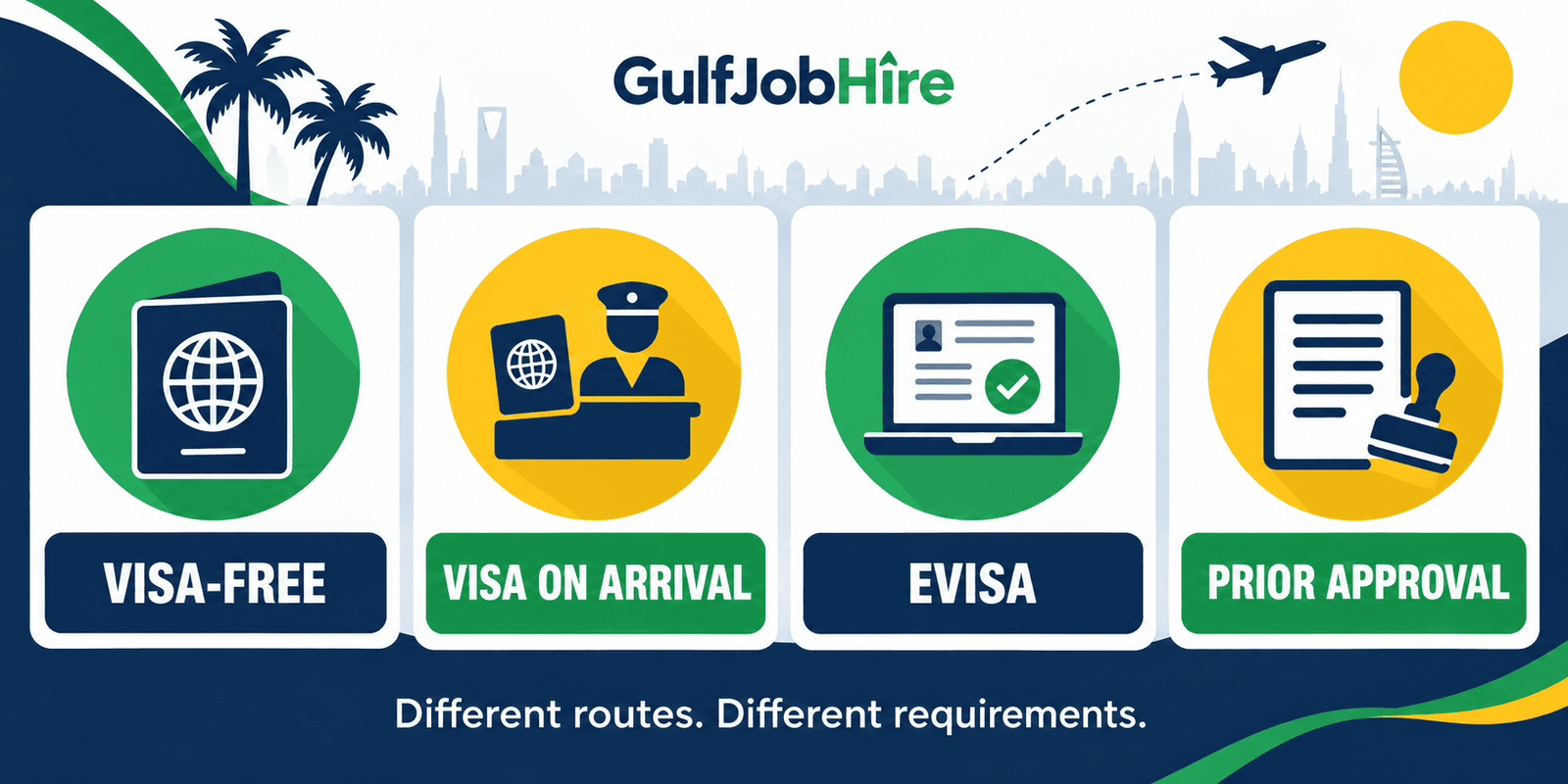
Understand the four travel permission types
- Visa-free: an eligible traveller may visit without obtaining a visa, subject to the exemption’s limits.
- Visa on arrival: a visa is still required, but eligible visitors obtain it at an approved entry point.
- eVisa: an online application route. Submitting an application or paying a fee does not equal approval.
- Embassy visa or prior approval: complete the required consular or immigration process before travel.
These terms answer different questions. A country may provide one route to a particular passport holder and a different route to another resident of the same Saudi city. An airline may ask you to show the permission that matches your passport and itinerary.
Keep the permitted stay separate from the visa’s validity. The first concerns how long you may remain after admission; the second may describe when a visa can be used. Count entries separately too: a single-entry permission normally cannot be reused merely because its printed expiry date has not passed.
1. Georgia: conditional visa-free travel
Saudi Iqama holders should check Georgia’s residence-based exemption using their nationality and Saudi residence details. The usual qualifying-residence route allows up to 90 days in any 180-day period, subject to the applicable conditions.
A Georgian government amendment effective 16 May 2025 imposes a special condition on 17 listed nationalities, including Pakistan and Bangladesh: the qualifying GCC multiple-entry visa and/or residence permit must have at least one year of validity on entry. The amendment expressly includes Saudi Arabia.
Use the official Georgian entry checker and read the government amendment. Do not assume that a nearly expired Iqama qualifies. If your documents fall outside the exemption, investigate the correct visa route before departure.
2. Armenia: temporary exemption with specific dates
Armenia’s Foreign Ministry announces a temporary exemption from 1 July 2026 to 1 July 2027 for nationals of 111 listed countries who hold qualifying residence permits, including Saudi permits. The permit must remain valid for at least six months from entry. Eligible visitors may stay up to 180 days within one year.
The ministry requires the residence permit as a physical card or passport sticker and describes Latin-script and Gregorian-date information needed for recognition. Pakistan and India appear on the published 111-country list. Check the document requirements on the official Armenia visa page.
Saudi Iqama holders should not describe this as a permanent benefit or assume that every nationality is covered. If travelling outside the stated dates, recheck the policy. A phone screenshot alone may not meet the published physical-document requirement.
3. UAE: arrange the GCC-resident eVisa first
The UAE government says GCC residents and their companions must obtain the appropriate online visa before arrival. This is an advance application route for Saudi Iqama holders, rather than an unrestricted visa-free visit.
The government page describes a 30-day entry validity and 30-day stay, with a possible one-time 30-day extension. It also lists passport, GCC residence and profession conditions. Check the current requirements with the authority processing your application; choose the service appropriate to your destination emirate.
Start with the UAE government’s GCC-resident eVisa guidance. Wait for approval and inspect the dates and passport details before travelling. A submitted form, payment receipt or agent’s promise is not the issued visa.
4. Oman: check the GCC-resident category and profession
Oman provides GCC-resident visa categories with eligibility conditions. The Royal Oman Police FAQ identifies category 29A for the qualifying main traveller in an approved profession and 29B for a companion. Saudi Iqama holders should use the eligibility service rather than assume all professions qualify.
The police FAQ also directs land travellers to apply through the eVisa website before using a legal border crossing. Check your precise category, accompanying-person requirements and document validity in the current application.
Use the Royal Oman Police eVisa portal and its official FAQ. Do not reuse requirements for an unrelated Oman tourist visa as proof that you qualify through GCC residence.
5. Bahrain: use the official eligibility result
Bahrain has a GCC-resident eVisa service, but Saudi Iqama holders should establish which visa is available for their nationality and journey. Use the official Bahrain eVisa website and read the conditions attached to the result.
Confirm whether you need advance approval or qualify for an arrival visa, and whether that permission covers your intended entry point. A plan to drive across the King Fahd Causeway deserves its own route check; an airport example shared by another traveller is not enough.
Where an online application is required, allow time for a decision. Match the passport details carefully and keep the issued permission available when travelling.
6. Kuwait: confirm the current MOI entry route
For Kuwait, Saudi Iqama holders should check the official Ministry of Interior visa portal before relying on an arrival-visa claim. This review did not establish a readable current official rule covering every nationality, profession and entry point.
That is a reason to confirm your case directly, rather than label Kuwait universally visa-free. Ask whether your nationality and residence qualify, what remaining validity is required, and whether the rule applies to your airport or land border.
If the portal cannot resolve your case, request guidance from Kuwait’s consular service. Keep a written response where possible and reconfirm boarding requirements with your carrier.
7. Jordan: qualifying residence can affect visa eligibility
Jordan’s Arabic Interior Ministry FAQ describes an arrival-visa route for qualifying ordinary-passport holders resident in GCC countries, with residence valid for at least six months. Other FAQ entries contain nationality-specific conditions. This remains a visa route, not a blanket visa exemption.
Saudi Iqama holders should verify the applicable nationality rule, supporting documents and intended border crossing with the Jordan Ministry of Interior FAQ or its official visa service.
Do not assume every land crossing processes the same permission. Obtain confirmation for your exact route before arranging a road trip or nonrefundable accommodation.
8. Egypt: nationality and visa channel matter
Egypt’s eVisa portal publishes a nationality list. Saudi residence by itself is not proof of eligibility for that online route. Pakistan is not listed in the portal’s published eVisa nationality list checked for this guide.
Saudi Iqama holders whose passports are outside that list should seek Egyptian consular confirmation about their correct visa route, including whether any separate residence-based arrangement applies to their case. This article does not confirm a universal 30-day arrival visa for all Saudi residents.
Check the official Egypt eVisa FAQ. Avoid selecting Saudi nationality in an application merely because you live in Saudi Arabia: nationality must match your passport.
9. Tunisia: confirm your passport’s requirements
This review did not verify a universal Tunisian visa exemption for Saudi Iqama holders. Treat Tunisia as a nationality-based check rather than a guaranteed Iqama benefit.
Tunisia’s official consular guidance directs visa-required applicants to the consulate covering their residence. Consult the Tunisian consular visa guidance and contact the appropriate mission for your passport and purpose of visit.
If your nationality is independently exempt, that is a passport benefit; if you need a visa, Saudi residence may help establish where to apply without removing the visa requirement. Keep those two questions separate when comparing destinations.
10. Japan: online tourism application is available
Japan lists Saudi Arabia among the places of residence from which eligible foreign nationals can apply through JAPAN eVISA for tourism. Saudi Iqama holders may therefore have an online application route, subject to the ministry’s conditions.
This does not make Japan visa-free. Check the current scope, supporting documents and electronic visa display instructions on the Japanese Foreign Ministry eVisa page. Approval is required before using the visa to travel.
Apply using your actual passport nationality and Saudi residence. Do not confuse eligibility to submit an online form with an entitlement to receive a visa.
Document checklist for Saudi Iqama holders
Build a separate document folder for every traveller. The destination’s own checklist decides what is mandatory; the following is a practical preparation list, not a substitute for that checklist.
- Passport with the validity and blank pages required for your destination.
- Current Iqama or other accepted residence evidence, with sufficient remaining validity.
- Approved destination visa or evidence that the precise exemption applies.
- Return or onward itinerary and accommodation details where requested.
- Travel insurance meeting the destination’s requirements, where applicable.
- Evidence of funds, employment or sponsorship if the application requires it.
- Separate documents and permissions for children and accompanying family members.
- Any required transit permission for the country through which you connect.
Check the Saudi side of your journey as well. Confirm your own exit/re-entry permission, return dates and residence status through official Saudi channels or your employer where appropriate. Destination permission and permission to return to Saudi Arabia are separate checks.
If you are still establishing your Saudi documents, our guide to finding an Iqama number by border number explains the available inquiry route. Before relying on SMS verification while travelling, review how to check SIMs registered on your Iqama.
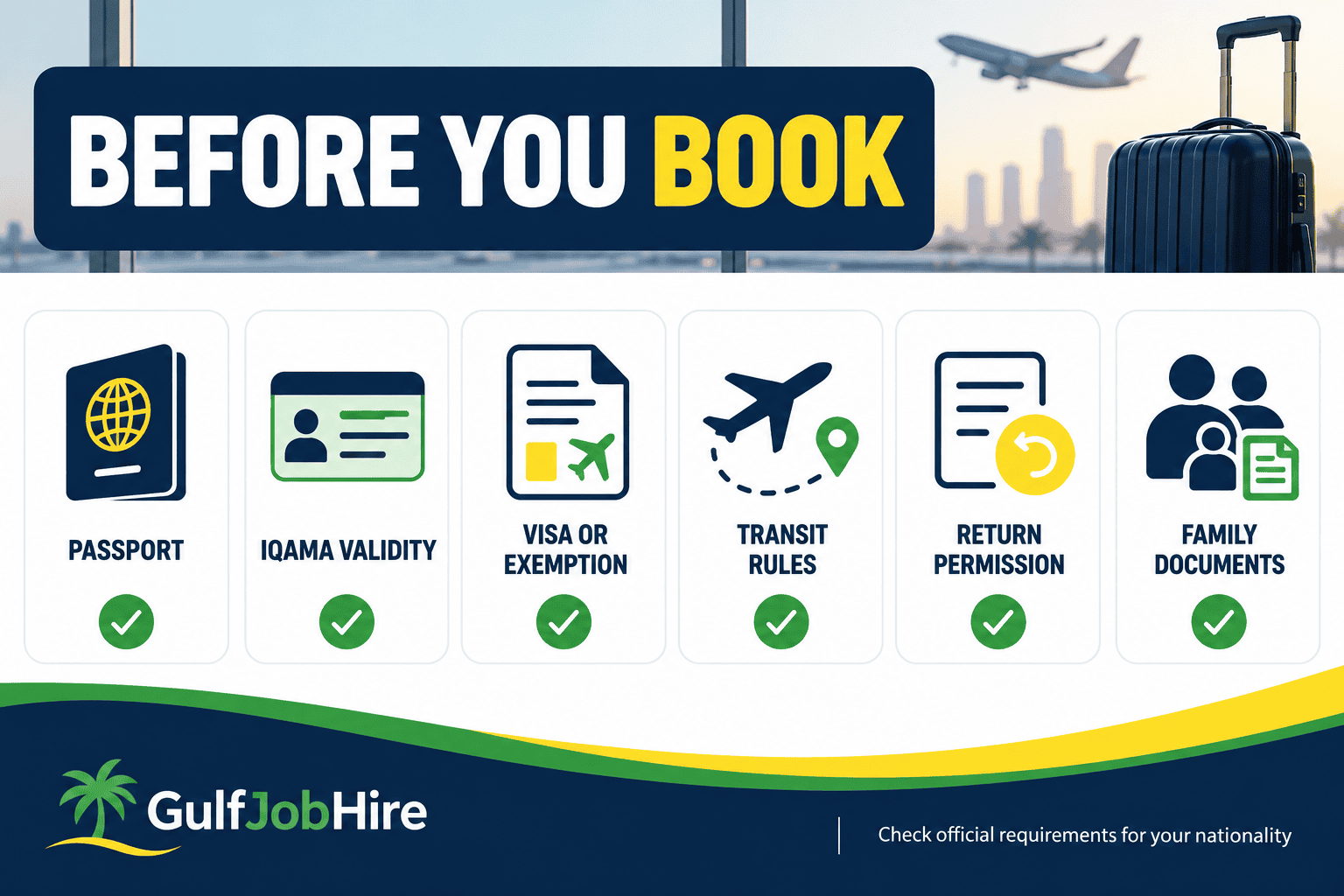
How to check eligibility before booking
- Write down your exact profile. Record passport nationality and type, residence expiry, profession if relevant, travel purpose and dates.
- Select the official destination service. Enter citizenship and residence separately. Avoid a result based only on “Saudi resident”.
- Read the complete conditions. Check remaining validity, permitted stay, number of entries, arrival point and accompanying-person rules.
- Resolve exceptions before paying. Ask the authority about any mismatch, expired physical card, unusual passport type or unclear requirement.
- Apply where required. Keep the reference number and wait for the actual decision.
- Check the issued document. Compare names, passport number, dates, entry allowance and purpose against your itinerary.
- Confirm the complete route. Check airline boarding requirements, transit conditions and your return to Saudi Arabia.
For example, two colleagues in Riyadh can receive different answers because they carry different passports. Even colleagues with the same nationality can have different eligibility if one has much longer residence validity or holds a profession that a particular visa category accepts.
A family should repeat the check for each member. A principal traveller’s eligibility does not automatically establish a spouse’s or child’s eligibility. Record which permission belongs to which passport so that bookings and applications remain consistent.
Common mistakes that cause avoidable travel problems
Using nationality and residence interchangeably: choose the nationality printed on your passport. Select Saudi Arabia only in the residence field when that is correct.
Relying on an old screenshot: a social media post may describe a previous policy or a traveller with different documents. Reopen the official page for your actual travel date.
Ignoring the return journey: review the planned Saudi return date, not just the outward departure. Leave enough time to handle document corrections before your trip.
Assuming digital evidence is accepted everywhere: check whether the destination needs a physical residence card, a printed visa, an electronic display or another format. Keep secure copies, but bring the required original.
Booking a connection without checking transit: airport changes, overnight stops and separate tickets may create extra requirements. Ask about the complete itinerary, especially if you must collect luggage and check in again.
Confusing a visit with permission to work: tourist entry does not establish permission to take employment. Saudi Iqama holders considering an overseas job must check the destination’s employment and residence process separately.
Keep sensitive documents private. Use official application channels and verified service providers. There is no reason to post your full passport, Iqama or visa reference in a public comment to ask a general travel question.
Frequently asked questions
Which countries are visa-free for Saudi Iqama holders in 2026?
Georgia and Armenia offer conditional residence-based exemptions worth checking. Eligibility depends on nationality, document validity and, for Armenia’s temporary scheme, travel dates. The ten destinations in this guide are not ten universally visa-free countries.
Can a Pakistani passport holder use the same rules as a Saudi citizen?
No. Pakistani nationality and Saudi residence are different facts. Check the destination’s Pakistani-passport requirements and any qualifying residence exception. Georgia’s special one-year GCC-document rule includes Pakistan.
Does an Iqama replace a passport?
No. Travel with your passport and the residence evidence required for the route. An Iqama alone does not establish international entry permission.
Is Japan visa-free with an Iqama?
No. Saudi residence can provide an eligible online tourism application route; you still need the appropriate approval unless independently exempt through another applicable rule.
Can I use the same documents for the whole family?
Check each person separately. Passports, residence validity, applications and accompanying-person conditions can differ within a household.
What if my Iqama expires soon?
Check the destination’s precise remaining-validity requirement and your Saudi return arrangements. Do not assume a permit valid on departure will satisfy every destination.
Does a valid visa guarantee boarding or admission?
No. You must still satisfy the applicable travel and entry conditions. Resolve document or itinerary issues with the responsible authority and carrier before departure.
Official sources and related GulfJobHire guides
Country sections link directly to the relevant immigration, foreign ministry or consular service. Recheck those pages when planning your trip, especially where a temporary exemption or nationality exception is involved. Where this review could not confirm a universal residence-based benefit, the article says so instead of presenting an unsupported promise.
GulfJobHire publishes practical information for people living and working in Saudi Arabia. Continue with our STC balance check guide or browse the GulfJobHire blog for related resident guides. Save this checklist for your next trip and share it with family members so that everyone checks their own documents.